From Import to Factory: A Practical Roadmap for Solar Panel Assembly in Africa
From Import to Factory: A Practical Roadmap for Solar Panel Assembly in Africa
Introduction: The Case for Solar Panel Manufacturing
Across Africa, the demand for energy is rising at an unprecedented pace. Rapid urbanization, industrial expansion, and the urgent need for rural electrification are putting pressure on already strained national grids. In this context, solar energy is no longer an alternative — it is becoming a necessity.
It is therefore natural for governments and investors to ask:“
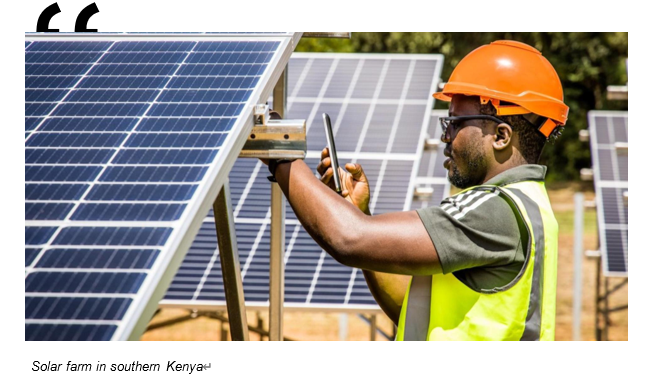
Why don’t we build solar panel manufacturing plants locally?”
Fact: Where is Africa now ?
At first glance, this seems like the perfect solution:
• Reduce import dependency
• Create jobs
• Build local industry
• Strengthen energy security
And indeed, the ambition is correct. However, the execution requires precision.
Understanding Solar Panel Manufacturing: The Full Value Chain
To make the right decision, it is important to understand what “solar panel manufacturing” actually means.
A complete solar manufacturing ecosystem includes:
Upstream (High Complexity)
• Polysilicon production
• Ingot formation
• Wafer slicing
• Solar cell fabrication
These stages require:
• Extremely high capital investment
• Advanced cleanroom environments
• Deep technical expertise
• Massive and stable energy supply
This level of manufacturing is currently dominated by countries like China, where decades of industrial development have created unmatched scale and efficiency.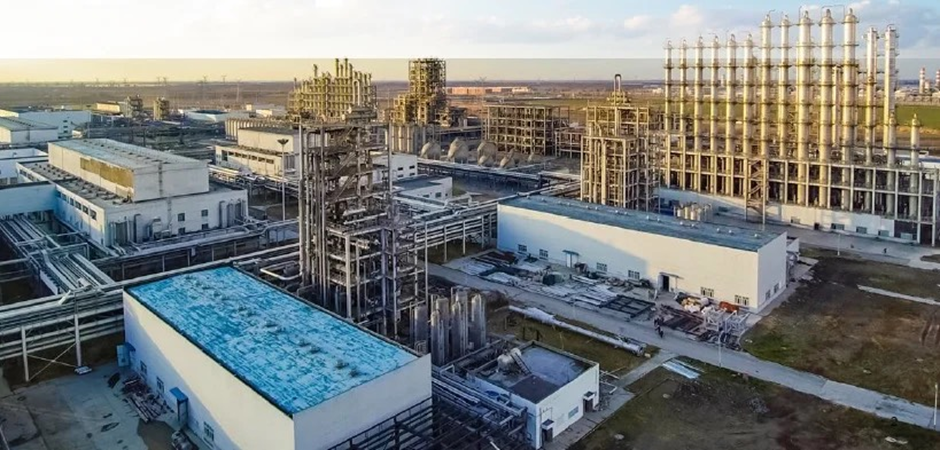
Daqo poly plant facility outside;
Midstream (Practical Entry Point)
• Solar cell integration
• Stringing and tabbing
• Panel layup (glass + EVA + cells + backsheet)
• Lamination
• Framing
• Junction box installation
• Electrical testing
This is where solar panels are actually assembled.
Downstream (Local Opportunity)
• Mounting structures
• Installation services
• EPC (Engineering, Procurement, Construction)
• Distribution networks
This is where Africa already has strong potential.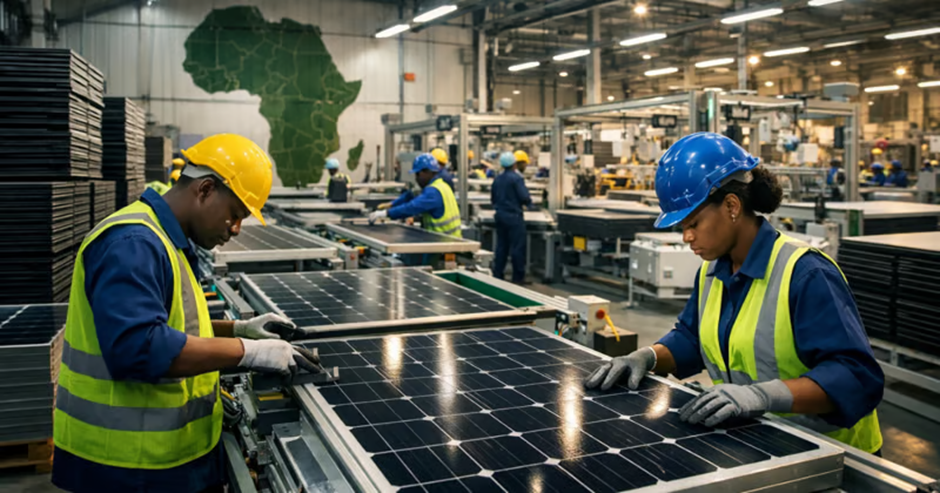
Solar Panel assembly Plant in Mali
Why Full Manufacturing Is Not the First Step
While the idea of full solar manufacturing is appealing, starting at the upstream level presents several challenges:
• High capital requirements (often hundreds of millions to billions of dollars)
• Technology dependency and complexity
• Long time to operational readiness
• Global price competition with established producers
Attempting to compete directly at this level can delay progress and increase risk.
The Smart Strategy: Start with Assembly
Instead of jumping into full manufacturing, a more effective and immediate approach is:
Solar Panel Assembly + Light Manufacturing
This model focuses on:
• Importing high-precision components (such as solar cells)
• Performing final assembly locally
• Gradually localizing selected components
Why This Approach Works
1. Immediate Industrialization
Assembly plants can be established within a relatively short timeframe, allowing countries to move quickly from policy to production.
2. Job Creation at Scale
Solar panel assembly is labor-intensive compared to upstream manufacturing.
A single plant can create:
• 80–200 direct jobs
• Hundreds of indirect jobs in logistics, installation, and services
3. Cost Efficiency
• Reduced shipping costs (compared to fully assembled panels)
• Lower import duties on semi-knocked-down components
• Faster delivery timelines
4. Skills and Technology Transfer
Partnerships with established manufacturers enable:
• Workforce training
• Process knowledge transfer
• Gradual industrial capability development
5. Foundation for Future Manufacturing
Assembly is not the end — it is the beginning.
It creates the base for:
• Local component production
• Industrial ecosystem development
• Future upstream expansion
The Role of Strategic Partnerships
Rather than competing with established manufacturing hubs, African countries can benefit from collaboration.
Working with partners from China allows access to:
• Proven technology
• Reliable supply chains
• Scalable production systems
This is not dependency — it is strategic integration.
What Should Be Localized in Africa
To maximize value, focus should be placed on areas where Africa has natural advantages:
• Assembly labor
• Aluminum framing
• Mounting structures
• Cable systems
• Installation and EPC services
• Regional distribution networks
This ensures that value is created locally while maintaining global competitiveness.
A Phased Development Roadmap
Phase 1: Assembly
• Import solar cells
• Assemble panels locally
Phase 2: Partial Localization
• Local aluminum frames
• Mounting systems
• Electrical accessories
Phase 3: Advanced Manufacturing (Long-Term)
• Glass processing
• Backsheet production
• Selected component manufacturing
Conclusion: From Import to Industry
Africa’s solar future does not depend on replicating the entire global manufacturing chain overnight.
It depends on making the right entry decision. Start with assembly. Build capability. Grow into manufacturing.
By transitioning from importing finished products to assembling locally, countries can:
• Strengthen energy security
• Create jobs
• Build industrial capacity
• Lay the foundation for long-term manufacturing
The Kichuguu Perspective
At Kichuguu, we believe industrialization is not just about ambition — it is about execution.
Solar panel assembly is a clear example of how practical strategy can transform an idea into a working industry.
From import to factory — this is how industries begin.
Phase 1: Solar Panel Assembly Plant
1. Project Overview
Project Type: Solar Panel Assembly Plant
Focus: Import solar cells → Assemble finished panels locally
Scale: Medium Industrial (Entry Level)
A typical solar panel assembly plant includes:
• Cell sorting
• Stringing and tabbing
• Layup stations
• Laminators
• Framing units
• Junction box installation
• Testing equipment (EL & IV testing)
• Packaging lines
Recommended Capacity
• 100 MW – 300 MW per year
Output
• Standard PV modules (e.g. 400W–600W panels)
2. Core Strategy
• Import high-precision components (cells, EVA, backsheet)
• Perform labor + process-based assembly locally
• Gradually localize:
• frames
• mounting systems
• wiring accessories
3. Production Flow (Simple View)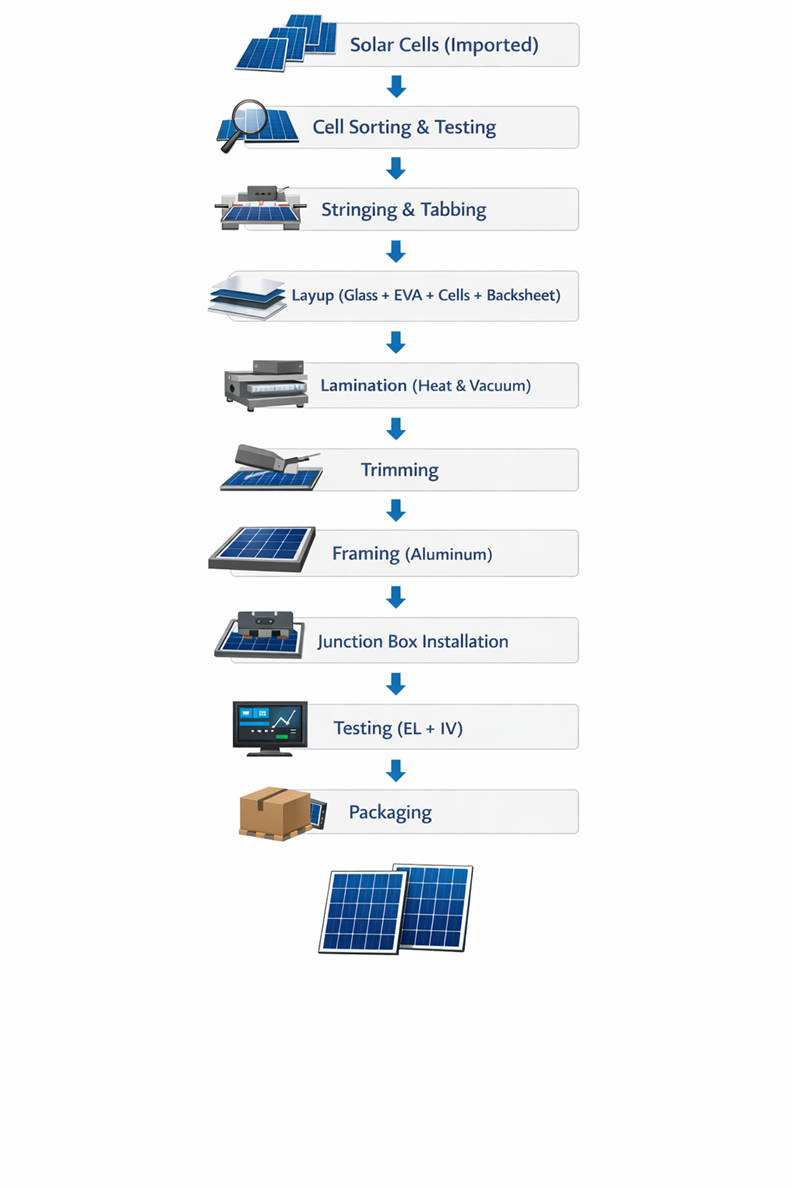
4. Key Machinery Required
A. Cell Processing
• Solar Cell Tester & Sorter
• Stringer Machine (automatic/manual)
B. Layup Section
• Layup Table (manual/semi-auto)
C. Lamination Section
• Solar Laminator (core machine)
D. Finishing Section
• Trimming Machine
• Aluminum Frame Assembly Tools
• Framing Machine (optional semi-auto)
E. Electrical Section
• Junction Box Installation Station
• Soldering Stations
F. Testing Section
• EL Tester (Electroluminescence)
• IV Tester (performance testing)
G. Packaging
• Conveyor system
• Packing tables
5. Factory Layout & Area Requirement
Minimum Recommended Area
| Section | Area (M2) |
| Raw material Storage | 300-500 |
| Production Line | 800-1200 |
| Testing Area | 200 |
| Finished Goods Storage | 400-600 |
| Office & Utilities | 200-300 |
| Total | ~2,000 - 3,000 |
6. Utilities Requirement
Power
• Estimated: 150 kW – 300 kW
• Stable supply required (backup generator recommended)
Compressed Air
• Required for pneumatic tools
Environment
• Clean, dust-controlled space (not full cleanroom)
• Temperature control preferred
7. Key Imports (China Sourcing Focus)
Critical Imports
• Solar cells (mono PERC / TOPCon)
• EVA sheets
• Backsheet
• Junction boxes
• Ribbon (tabbing wire)
Optional Imports (initial phase)
• Aluminum frames (can localize later)
• Glass (if not available locally)
8. Local Supply Opportunities (Africa Advantage)
• Aluminum frame fabrication
• Mounting structures
• Packaging materials
• Electrical cables
• Installation services
9. Labor Requirement
Direct workforce
| Role | Number |
| Line Operator | 40-80 |
| Technicians | 10-20 |
| Quality Control | 10 |
| Suoervisors | 5-10 |
| Admin/ Support | 10 |
| Total | ~70-120 |
Skills Needed
• Basic electrical knowledge
• Machine operation
• Quality inspection
• Light engineering skills
(Training can be provided by Chinese partners)
10. Investment Estimate
| Level | Estimate |
| Basic (semi- Auto) | $3M - $5M |
| Advanced (Auto Line) | $6M - $10M |
11. Time to Operational
• Equipment procurement: 2–3 months
• Installation & setup: 1–2 months
• Trial production: 1 month
12. Output Economics (High-Level)
Revenue Drivers:
• Panel wattage (400W–600W)
• Local demand (government + private sector)
• Solar projects (EPC integration)
Cost Advantage:
• Reduced Freights charges import duties
• Lower logistics cost
• Faster project supply
13. Expansion Potential
After stabilization:
Add:
• Frame manufacturing
• Mounting systems
• Cable production
Later:
• Glass processing
• Partial component manufacturing
14. Strategic Impact
For Government:
• Job creation
• Industrial base development
• Reduced import dependency
• Energy security
For Investors:
• Fast ROI
• Scalable
• Strong demand-driven sector
Kichuguu Conclusion
Solar panel assembly is more than an energy project — it is a strategic entry point into industrialization.
By starting with assembly, countries can move immediately from consumption to participation, building technical capacity, creating jobs, and laying the groundwork for a broader manufacturing ecosystem. It is a practical, scalable, and economically sound pathway that aligns with Africa’s current strengths while preparing for future industrial depth.
At Kichuguu, we believe that industrial development does not begin with ambition alone — it begins with the right structure, the right partnerships, and the right execution strategy.
From import to factory — this is how industries are built.
For governments, investors, and institutions seeking to explore similar industrial opportunities, Kichuguu provides the insight, technical know-how, and execution support required to turn ideas into operational projects.
To explore more industrial concepts, factory models, and practical implementation strategies:
Visit: www.kichuguu.com; Contact: info@kichuguu.com